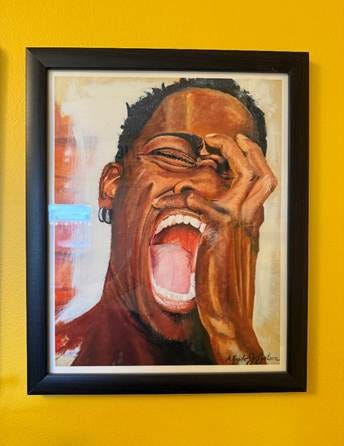
I have this painting hanging in my office, next to my desk. It was painted by a family friend, Alfredo Carlson. He painted it in June 2020, about a week after George Floyd’s murder, in the summer of what some call the U.S.’s “racial reckoning.” (Or as CNN unironically titles it in an otherwise well-done interactive piece, “2020: The year America confronted racism.” Good thing we took that year to confront our issues and move on, healed.)
Here’s what he wrote about it on his Instagram page: “I am thankful for the relief that was meant to come through the power of art. It is certainly a blessing to create something and in the process, put your heart into it and feel its healing powers. Despite the world being in chaos, a black mans plea for justice is met with anger, more hate and mockery. As I was finishing this painting which was originally meant to illustrate my own personal grief, I realized how much work still needs to be done for minorities to have our voices be heard.”
I’ve spent a lot of time looking at this painting the last few days. I am not Black, but the anguish and grief that jumps out at me from this painting has really resonated lately, and I know I’m not alone. So many of my colleagues have been communicating the same, especially in the last few weeks. We’re trying to be strong in the dystopian marathon we’re running. We know we can’t give up. But damn, we’re depleted.
Shortly before 5pm on Friday, Patrick Joseph White went to the Centers for Disease Control and Prevention headquarters in Atlanta and fired nearly 500 rounds at the buildings there. It was originally reported as a shooting on the adjacent Emory University campus, presumably since school lockdowns for active shooters in this country trigger alerts on every news desk these days. But it’s now clear this wasn’t a school shooting. It was an attack on public health itself.
150 rounds went into the blast-resistant glass of CDC headquarters, many of them piercing the building. Frightened employees were locked down for hours, not being released to leave until nearly 11pm, while their families waited anxiously to hug them. DeKalb County police officer David Rose was murdered, leaving behind a pregnant wife and two small children. The latest thinking seems to be that the shooter may have been motivated by anti-vaccine sentiment, blaming the CDC for his own health issues that he believed were the result of the COVID-19 vaccine.
And yet, many people don’t even know this happened. The silence was—and has been—deafening.
Jerome Adams, who was surgeon-general during Trump 1.0, posted on X the next morning, “Over 12 hours after the terrorist attack at CDC headquarters, reportedly linked to vaccine grievances, and @SecKennedy has yet to condemn this horrific act. How one leads in a crisis matters, and silence speaks volumes.”
Hours after Dr. Adams’s post, RFK Jr. posted photos from a fishing trip in Alaska on his personal profile on X. Half an hour after that, there was post on his official account finally acknowledging what had happened. “We are actively supporting CDC staff on the ground and across the agency,” he wrote. “Public health workers show up every day with purpose — even in moments of grief and uncertainty. We honor their service. We stand with them.”
You can imagine that it hasn’t felt like RFK Jr. is standing with the workers of the CDC. (He has, after all, called it a “cesspool of corruption.”) In an opinion published in STAT on Saturday, Jerome Adams went further than his original tweet, saying “It took more than 18 hours for Health and Human Services Secretary Robert F. Kennedy Jr. to issue a public statement condemning the violent act. In that time, I personally heard directly from CDC employees — already demoralized by DOGE-led budget and staffing cuts — who felt abandoned by the very leadership meant to defend them. Leadership in moments of crisis is critical. Kennedy’s delayed and tepid response, coupled with his own record of inflammatory claims, has only deepened the wounds and amplified a dangerous sense of betrayal among America’s frontline public health workers.”
RFK Jr. did finally make an effort to go to CDC…3 days after the attack. As one staffer said, “Is that a joke? There was no one there. The building is riddled with bullet holes and everyone is working from home.” He made a few political visits within a mostly empty building, and left.
In the STAT opinion, Dr. Adams went on to say:
What ties these events together is not just the violence — but the context that enables it. Repeated rhetoric from influential voices, including Kennedy and his supporters, has portrayed health professionals as corrupt, untrustworthy, or outright malicious. They’ve been labeled “grifters,” “enemies of the people,” and worse. One particularly telling — and troubling — comment came from Vinay Prasad, a high-level FDA official handpicked by Kennedy. (He recently left his position only to return weeks later.) After being asked whether Americans should forgive public health figures for their missteps, Prasad responded: “I don’t believe in forgiveness because in my opinion these pieces of shit are still lying.” This raw, venomous language from a senior public official doesn’t just reflect deep frustration — it helps fuel a culture of dehumanization that may instigate real-world violence.
He ended the piece with something that feels to me like it should be obvious, but apparently it isn’t: “Public health workers are not the enemy. They are our neighbors, our caregivers, our scientists, and our first line of defense in future crises. The CDC shooting should be a wake-up call — not just for policymakers, but for all of us. It’s time to reject the rhetoric that dehumanizes those trying to keep us safe and take real steps to protect them.” [text bolded by me]
Your Local Epidemiologist (Katelyn Jetelina) posted something similar this morning. “It’s exhausting. The public health field has been the punching bag for six straight years, yet some of us are the very ones who are trying to change and reimagine the systems. Many of us are choosing listening over judgment—seeking to build bridges and understand those who have felt marginalized by health policies. To extend empathy and then be met with bullets feels demoralizing, to put it mildly.”
She also said “And it’s lonely. The silence. The absence. The indifference. Without genuine acknowledgment or visible solidarity from federal leadership, the weight of this moment feels even heavier and, at times, permissive.”
I’m not just writing today to ask you all to be kind to your fellow health workers—though please, please do that. I’m writing to implore you to act, especially if you don’t work in public health, and haven’t already been very active trying to stem the tide of destruction that’s been happening since January 20th (and before).
Luckily for us, Drs. Adams and Jetelina have already offered some concrete solutions of what you can do, so I’m going to pass those along to you.
Dr. Adams offers that “What can — and must — be done now” is:
-
Leadership must speak up. The administration must forcefully and unequivocally condemn rhetoric that vilifies public health professionals. Public trust starts with leaders affirming the value of science-based public health — and the people behind it.
-
Stop scapegoating. Leaders should stop misdirecting public frustration about systemic health challenges toward the individual health professionals trying to solve them. Demonizing doctors, scientists, and public health agencies fuels violence and delays solutions.
-
Protect health care workers. Congress should immediately pass the Workplace Violence Prevention for Health Care and Social Service Workers Act, which would require comprehensive violence prevention plans in health care settings, including better training, incident tracking, and protections for workers.
-
Fund solutions, not slogans. In 2024 then-Surgeon General Vivek Murthy declared gun violence a public health emergency, citing over 48,000 gun-related deaths in 2022. Whether or not one agrees with that classification, the numbers — and now targeted attacks on public health institutions — demand real action. We must fund research and prevention strategies, not just arm more “good guys with guns” or offer thoughts and prayers.
Dr. Jetelina (YLE) says this is what you can do to help:
-
Support the family of the fallen officer. A law enforcement officer gave his life protecting CDC employees that day. If you’re able, contribute directly to his family through the CDC Foundation.
-
Write in to support public health workers. For this post, we turned on the comments section for everyone. Drop a note in there, and I will compile for CDC employees. Another option is a handwritten note or heartfelt email. It can mean more than you think. We created a template to make it easy—you can adapt it, sign it, and send it to someone who has shown up for your community.
-
Understand and acknowledge secondhand trauma. Learn the steps you can take as an individual and/or in the workplace to mitigate the impact of secondary trauma.
-
Humanize healthcare workers, public health workers, and scientists. Share a story of a public health success in your community, or highlight the person behind it. Maybe we even need someone to jumpstart a campaign like Hero and Human to highlight the fact that health workers are both, while demanding systems change.
-
Learn the warning signs and tools for crisis prevention. Educate yourself about Extreme Risk Protection Orders (ERPOs) and other tools to intervene when someone poses a danger to themselves or others.
-
Resist dehumanizing the “other side.” There’s nothing quite as dehumanizing as violence—actions that say “your life doesn’t matter.” As humans, when we’re under attack, it’s so easy to respond by treating our attackers as a two-dimensional villain. This may feel justified in the moment, but ultimately, it can continue the cycle that drives polarization and violence even more. Refusing to dehumanize our attackers (both physical and verbal) breaks the cycle. This doesn’t mean pretending things are ok, tolerating mistreatment, or not responding—but it does mean treating people with dignity in our responses, even when they aren’t affording us the same treatment. This does two things: 1. It stops escalation, and 2. It shines a brighter light on the reality of their mistreatment, because it’s contrasted with our response demanding dignity and respect for all humans.
I can’t say it better than that. We need you all to stand with us. Please support, and please share. The more we can unite and work together, the better—and safer—we’ll all be.