Fearless, funny, and expertly vetted updates on what is happening to public health in the US.
In Monday’s update I talked about the ways this administration is attacking our access to food by ending the USDA’s annual report on household food security, obscuring our ability to know when children and adults were going to bed hungry in the US. I quoted nutrition expert Lindsey Smith Tallie, who was in the Wall Street Journal saying, “I think the only reason why you wouldn’t measure it is if you were planning to cut food assistance, because it basically allows you to pretend like we don’t have this food security problem.”
Well, never mind that—they’re not even trying to hide it. They know there’s a huge and inexcusable problem of food security in this wealthy country, and they’re using it as a political wedge. They are using the millions of people struggling to put food on their tables as a political wedge, to be clear.
On Saturday, millions of Americans are going to lose access to SNAP benefits, aka EBT cards, aka “food stamps”. Before the government shutdown began, the USDA had a shutdown lapse plan on its website that said “Congressional intent is evident that SNAP’s operations should continue since the program has been provided with multi-year contingency funds that can be used for State Administrative Expenses to ensure that the State can also continue operations during a Federal Government shutdown.” But that plan has been deleted and now the administration is arguing that the contingency fund is not available to support regular benefits in FY 2026.
Let’s be clear: there is emergency funding available to help people pay for the food they need to have their families not go hungry, and the Trump administration is choosing not to use it, and just let people suffer.
Instead of making sure people have the food they need, Trump and his political appointees are using this to try to force Democrats to cave and agree to Republican demands, passing the Republican budget despite the ways it will harm Americans.
How do I know this to be true? Because this is at the top of the SNAP webpage at USDA.gov:
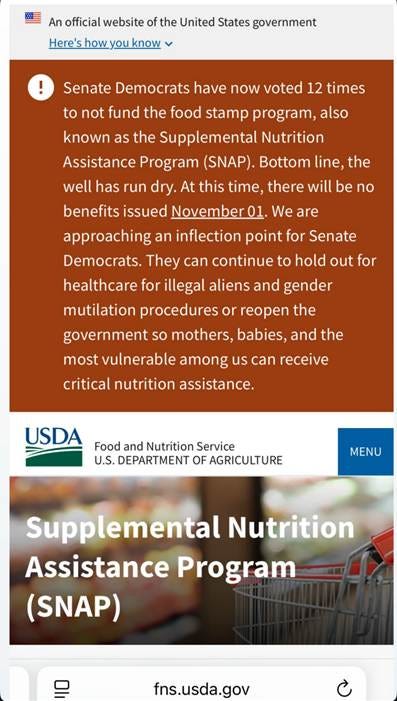
This is not only unethical and probably illegal, but it’s blatantly false. Let’s set things straight: Democrats are fighting to renew Affordable Care Act tax credits that make health care premiums more accessible. This is not about ensuring that undocumented people can access the healthcare they need (though that would be laudable) or about ensuring that trans people can access the gender-affirming care they need (though that would be laudable), regardless of what partisan and mean-spirited banners these folks want to put at the top of their webpages.
Open enrollment begins for health insurance plans on the ACA marketplace on November 1, and 24 million people use this system to buy health coverage. Despite the fact that more than 3 out of 4 people across the political spectrum are in favor of Congress extending the tax credits that make these ACA plans more affordable for people, the One Big Beautiful Bill Act set them to expire on December 1, and the Republican budget did not put them back—one of the main reasons Democrats have refused to pass it. Democrats are saying they won’t agree to a budget that doesn’t restore these subsidies, and Republicans are saying they won’t negotiate while the government is closed because Democrats are standing firm.
As a result, the tax credits will expire December 1. Even if the subsidies are extended before that deadline (possible, since Republicans are definitely starting to feel the pressure), when people start logging onto their local exchange for open enrollment on Saturday they’re going to have sticker shock. Some of you may have already gotten letters telling you how much your premiums will go up—sometimes doubling or even tripling the amount you’ve been paying.
Back to SNAP. Besides the fact that Democrats have not “voted 12 times to not fund the food stamp program” but rather voted 12 times to preserve people’s health insurance premium subsidies, here are a few other things to know:
-
A default on SNAP has never happened before. This administration is the first in history that is willing to let Americans go hungry over political wrangling in Washington.
-
A total of 41.7 million low-income Americans (1 in 8 households) receive an average of $187 a month from SNAP to buy food. Of those Americans, 39% are children and 19% are adults over age 60. That’s almost 2/3 of more than 40 million people who are kids or elderly (sorry, Mom and Dad…nearly elderly).
-
If you’ve heard people say things like “Sheesh, 40 million Americans get food stamps? What happened to working to put food on the table?” then here’s what you can say in response:
-
Of working-age Americans who are not disabled and receive SNAP, more than half worked the same month as receiving benefits, and about 3/4 worked within the same year as receiving benefits. Many people work in low-paying jobs and still need SNAP benefits to feed their families, even if working full-time.
-
The average monthly benefit from SNAP is $6 per person per day. If that’s enough for people to say “Nah, I don’t need to work, I have SNAP” then I want to know where they’re shopping.
-
1.2 million US veterans, 13,000 active-duty military, and 213,000 National Guard members receive SNAP benefits. Think about that when you’re hearing about these National Guard deployments to war-torn US cities like Portland or DC. Not only are these folks being forced to be deployed against their own neighbors, but after Saturday many of their families will be going hungry while they do it. What happened to “Support the Troops”??
-
-
It’s not just putting food in bellies, either: without SNAP benefits, millions of people will be forced to spend less at local grocery stores. This affects the local economy, and the livelihoods of people who work in those stores. This can, in turn, drive up the cost of groceries to keep the store sustainable, which affects everyone.
Although some states are committed to filling the gaps so their residents continue to receive SNAP funding, most have not, and more than half of US states have confirmed that if nothing changes their lowest-income residents will have to go hungry starting Saturday. About half the states announced yesterday that they are suing the Trump administration over its decision not to tap the contingency funds, but it’s hard to know what will happen with that (and regardless, 25 states aren’t part of that lawsuit, leaving their residents vulnerable).
So what can YOU do?
This administration is showing us they don’t care if we go hungry, or if our neighbors can’t feed their kids despite their full-time, low-wage job. So, we’re going to have to take care of each other, and show what being an American is supposed to be. Here are some ideas, borrowed from Nicole Cardoza at Reimagined, and Elisabeth Marnik at From the Science Classroom:
-
If you’re expecting trick-or-treaters at your home, think about having extra offerings for those who might need more than candy. You can get instant mac and cheese, oatmeal, or ramen in bulk for cheap, and it will fill empty bellies. Leave them in a container on the front step with a sign, so people don’t have to raise their hand and ask for the nourishing food.
-
Support your local free fridge program, if there’s one near you. Check with organizers to see what they need. Is it volunteer support? A financial donation? Dropping off a few things each week? Or organizing a cooking or baking party and offering to stock a fridge for a whole day? If there’s no local free fridge program near you, check with neighbors who have a Little Free Library and see whether they’d be amenable to adding a few donated cans of food or boxes of dry goods to their shelves.
-
Donate to your local food bank – cash if you can, instead of specific canned items or dry goods, which they might already have overstocked. Better yet, reach out to learn more about what they need most! You can use that intel to organize a food drive at your work, school, or other community location.
-
Call your local school, and ask how you might be able to support students in need, or their families. Your school might have a food security initiative already in place, or they might be open to having you drop off extra snacks they can distribute to students they know need an extra nutritional boost.
-
Keep an eye out on social media or through word of mouth for a family that might need extra help. Apps like MealTrain, Instacart, and DoorDash allow you to send gift certificates or send someone food without sharing your payment information. Or, you can offer to purchase and deliver groceries yourself, or deliver a home-cooked meal to someone who wants it (but ask first about allergies and food likes/dislikes! Being hungry isn’t reason to make someone eat a food item they hate when that can be avoided). Try to message it as something you are doing to be neighborly, not something you’re doing because you know they’re struggling. No one wants to feel like a burden.
-
Call your representatives. Yes, again. Urge them to act on food access AND on health care. Especially if you live in a district with Republican representatives, use this form to demand action to end the shutdown and preserve food access for families. Even better, use this guide from Your Local Epidemiologist to build strong relationships with your representatives so your voice can really carry.
Let’s show ‘em what we’re made of, America. Our government should take care of us. But if they won’t, we won’t let our neighbors go hungry.
What in the Health?!
Fearless, funny, and expertly vetted updates on what is happening to public health in the US.