Almost a year ago, I wrote a post about all the ways trust is being damaged between the public and public health, a field that is inherently about trying to help the public through providing trusted advice about what will keep them healthy.
Specifically, I posed two questions: How did we get to a place where so many Americans don’t trust public health experts (even before January 2020)? And especially since January 2020, how do people who are not public health experts know who to trust when it comes to public health information?
In the end, there were three takeaways:
1. Don’t trust CDC leadership,
2. Look to other sources for public health information (and I provided some options), and
3. If you are a public health professional, focus on rebuilding trust wherever you can.
So how have things evolved over the last year, since I made that post?
RFK Jr. and all the CDC leadership invested in pleasing RFK Jr. have constantly said they’re restoring trust.
RFK Jr. published an op-ed in the Wall Street Journal entitled “We’re Restoring Public Trust in the CDC.” The CDC’s own website has a page on CDC Priorities that says “As illustrated by the Trump Administration’s Executive Order on ‘Restoring Gold Standard Science,’ CDC will conduct all science in a manner that is reproducible; transparent; communicative of error and uncertainty; collaborative and interdisciplinary; skeptical of its findings and assumptions; structured for falsifiability of hypotheses; subject to unbiased peer review; accepting of negative results as positive outcomes; and without conflicts of interest. CDC is committed to restoring a gold standard for science to ensure that federally funded research is transparent, rigorous, and impactful, and that all decisions are informed by the most credible, reliable, and impartial scientific evidence available.” Sounds good, right? At her confirmation hearing on July 15, new CDC Director Erica Schwartz said her first priority would be “restoring trust in public health institutions through radical transparency and unwavering scientific integrity.”
But what does all this mean in practice? The CDC Priorities page is obviously a political platform. There are sections on that page with political statements and non-scientific stances on immigration, abortion, homelessness, gender, DEI and parental rights. (How could parental rights be political and controversial, you ask? Here’s what the page says: “CDC believes parents are the primary decision-makers in their children’s education and should have full authority over what their children are taught.” You can imagine what comes next…or you can read the page for yourself.) The CDC’s Priorities Statement at the top of the page ends with a pledge of compliance: the CDC’s priority is “ensuring compliance with the goals and priorities of the Trump Administration and HHS.”
Here’s the thing. The CDC Priorities page concedes that trust in public health has fallen due to inconsistent messaging and lack of transparency from that institution and other public health entities. I agree with that diagnosis! The problem is that their treatment is making it much, much worse.
As I’ve said repeatedly, public health professionals are not synonymous with the political shills doing RFK Jr.’s bidding—and this includes career scientists still desperately trying to do good work at CDC.
This point matters a lot. Tell your friends and family. In February 2026 Annenberg did a poll of people throughout the US, and found they had 67% confidence in career scientists at CDC, NIH and FDA, versus 43% in agency leaders. They call it a “stark divide,” but in my opinion the difference here should be a lot bigger.
This tension between scientists and political appointees is playing out in real time and sometimes we get a glimpse of it. In September, Inside Medicine did an exposé on CDC’s reporting on measles, complete with screenshots you can still see on that post, if interested. Dr. Jeremy Faust, who writes that Substack, wrote, “A screenshot of the CDC’s internal measles outbreak dashboard indicates that the agency itself continues to believe that the two deaths reported by Pennsylvania are indeed confirmed. Screenshots from the system were obtained by Inside Medicine and confirmed for authenticity by active CDC staff.” Yet the public website didn’t count those deaths, and only included an asterisk with a footnote (more on that in a moment). Inside Medicine explained it this way: “In other words, the CDC’s epidemiologists and scientific officers continue to believe that these deaths are confirmed, and are neither provisional nor caveated in any way. This is in contrast to Secretary Kennedy’s public messaging and, now, that of the CDC Director herself.”
CDC’s official handling of measles under the leadership of Director Schwartz has been exactly the type of thing that destroys trust.
Let’s look at this issue that Inside Medicine highlighted as a case study. Pennsylvania announced two measles-associated deaths on Aug 25. On August 28, CDC delayed its weekly measles data update. On August 29, RFK Jr. appeared in a Fox News Town Hall calling them “so-called measles deaths.” On August 30, the internal struggle appeared visibly on the public-facing website, ultimately ending in the posting of an asterisk and footnote instead of the 2 deaths:
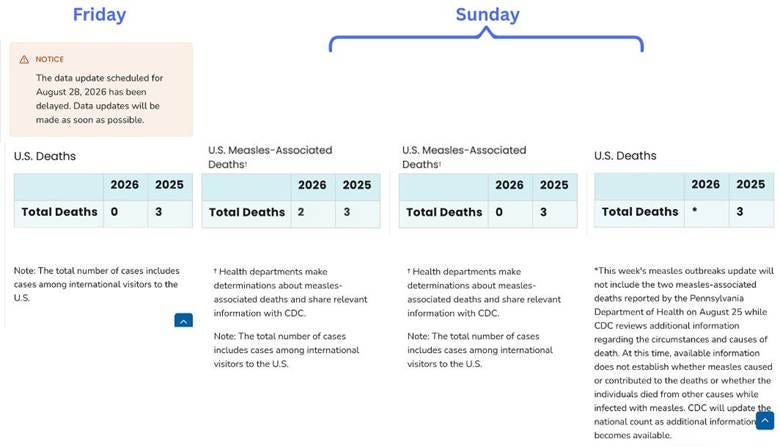
Indeed, Reuters reported that RFK Jr. himself specifically asked Schwartz to exclude these deaths from the public-facing website—and she clearly went along with it, only about six weeks after promising to restore trust in CDC during her confirmation hearing. By September 5, another Inside Medicine report said the internal site had been changed to match the public one. Cool, cool.
As of October 8 (the most recent update at the time of this posting), the CDC is reporting that there have been 4,080 official measles cases to date this year in the U.S., and 2* deaths. Yet, the State of Pennsylvania is reporting five deaths – two infants and two unvaccinated, and a third unvaccinated person whose age is not yet reported. So the gap between what the PA Department of Health is reporting and CDC is reporting is only growing.
Why might this be happening? The CDC announced on Sept 4—right around the time there was an apparent internal struggle about what should appear on their website—that it would stop drawing measles death counts from the National Notifiable Diseases Surveillance System (NNDSS), which carries case reports from states, and rely instead on the National Center for Health Statistics (NCHS). This is very confusing to anyone who understands these data systems, and has led numerous people to claim it’s a politically motivated choice, not one displaying “unwavering scientific integrity.” In short, NNDSS is near real-time for high-consequence diseases like measles. Within this system, data flows from locals to states to the feds, and CDC’s job is to aggregate and report it. Pennsylvania reported its deaths through NNDSS as “measles-associated.” They should be counted. That’s the point of the system. NCHS, on the other hand, doesn’t determine cause of death. NCHS can verify individual records within weeks, but its data releases lag months, which is why it isn’t built for outbreak tracking. To me, it only makes logical sense to make this shift if you’re trying to delay reporting of deaths. Say, until after the midterms?
It’s become clear that under this administration, science that doesn’t fit their narrative gets blocked.
Let’s look beyond measles. Let’s take CDC’s COVID vaccine effectiveness report. This report was scheduled for publication on March 19 in CDC’s Morbidity and Mortality Weekly Report, which more than a hundred thousand subscribers (mostly public health professionals). The study found vaccination cut ED visits by 50% and hospitalizations by 55% among healthy adults. The same method had been used in a flu study published a week earlier than the COVID study was scheduled to run, and this COVID report had already cleared CDC’s scientific review process. Yet before it was released CDC staff received news that its publication would be delayed. On April 22, the Washington Post reported that then-acting CDC Director (and simultaneous NIH Director) Jay Bhattacharya had officially cancelled publication due to “concerns about methodology.” Former CDC officials noted that stopping publication after CDC already had cleared it in scientific review is highly unusual. The study was eventually published June 23 in JAMA Network Open, which is independent from the U.S. Government.
Similarly, on May 5 the New York Times reported that FDA blocked studies supporting the safety of COVID and shingles vaccines. In October 2025, FDA scientists were directed to withdraw two COVID-19 vaccine studies that had already been accepted for publication in top medical journals. In February 2026, FDA scientists wanted to submit abstracts about the safety of Shingrix, a shingles vaccine, to a major drug safety conference, and top FDA officials refused to sign off. These studies were elaborate efforts and took millions of taxpayer dollars. Not reporting on the findings is not only scientifically unethical, but a waste of all of our hard-earned money.
Remember how the CDC Priorities page promised “unbiased peer review” and science “communicative of error and uncertainty”? Peer-reviewed work is being blocked, but the vaccine-skeptic items on the CDC’s autism page—the very unscientific and politically-motivated claims that prompted my initial rant about trust in November 2025— are still there.
There are numerous other bits of evidence that what they are saying is not what they are doing. Watch the actions, not the words.
Remember in my November post when I mentioned (with citations) that RFK Jr. was financially invested in creating the appearance of a real link between vaccines and injury or death? On June 4, Merck reportedly settled most of its litigation about Gardasil (the HPV vaccine) for around $50 million. RFK Jr. had planned to keep a 10% referral fee, but there was so much Senate pressure that he initially agreed to transfer his stake to his son—and later stated that he’d give it back to his former employer instead, with nothing going to his family…though his former employer also happens to be his son’s current employer. Multiple Democratic senators are questioning whether that squares with his earlier ethics filings, and whether his family stands to benefit. (I wonder why.) What happened to the pledge on the CDC Priorities page to conduct science “without conflicts of interest”? What happened to RFK Jr.’s proud gutting of ACIP because of alleged conflicts of interest?
Oh, and then there was RFK Jr. saying, and I quote, “First of all, there are no cuts in Medicaid,” during an April 22 hearing. Non-partisan FactCheck.org rated it misleading: yes, as RFK Jr. said during the hearing, federal Medicaid spending is expected to grow by 47% over the next 10 years. But that’s a disingenuous technicality (my words, not theirs), because the Congressional Budget Office estimates that HR1 is going to result in about $900 billion worth of cuts over those 10 years, compared to what would have happened without the bill. (Meaning, due to projected increases in health costs and population size, if people’s access to and utilization of Medicaid stayed the same, the costs would be an additional $900 billion over the 47% growth RFK Jr. is referencing.)
Besides, remember that Hantavirus quarantine? That was only about 5 months ago, but so much has happened it already feels like an absurdity from the distant past. Americans from the cruise ship were held in a federal facility on orders signed by acting director Bhattacharya, after CDC’s own medical reviewer and outside experts recommended home monitoring instead. Your Local Epidemiologist reflected on it with unusually cutting remarks: “This is the same guy who built a public profile arguing that the Covid-19 response went too far against medical freedom, now taking away more freedom from U.S. citizens than CDC scientists deemed necessary. (And an Administration that continues to discredit, undermine, and disparage scientists working during the Covid-19 response.)”
So what are the consequences of all of this? Are our leaders restoring trust in public health?
According to a poll by Harvard T.H. Chan School of Public Health and the de Beaumont Foundation in Spring 2026, trust in CDC recommendations dropped from 77% to 50%, with trust among Democrats falling from 92% to 34% and trust among Republicans rising, from 63% to 67%. In case you’re feeling like that might be biased polling, in September 2024, 72% of people polled by Annenberg said they trusted CDC. By August of 2026, that number is down to 61%. (NIH is polling similarly at 61%, and FDA at only 59%, also dramatically down from polling in 2024).
But really, the proof is in the pudding, not in what people say in polls. Using CDC’s own numbers, in 2025 there were a total of 2,289 measles cases, and this year we’re already past 4,000. And yet, only 92.4% of kindergarteners in the 2025-2026 school year had received the MMR vaccine, leaving about 280,000 kindergarteners susceptible to the outbreaks our country is currently experiencing. This might sound like a lot to you, but the widely accepted threshold for herd immunity for measles is 95%. In other words, if fewer than 95% of people in a community are vaccinated (i.e., more than 5% are susceptible to this incredibly contagious disease), you will have outbreaks. Clearly this is not a hypothetical notion: we are watching this play out in real time in the U.S. as we speak.
I think the answer is clear: our leaders at the very top are not restoring trust in public health. They clearly never wanted to in the first place. But there are public health leaders who are working hard to restore trust.
-
The American Academy of Family Physicians, American Academy of Pediatrics, American College of Obstetricians and Gynecologists, and Infectious Diseases Society of America have teamed up to provide vaccine recommendations for the 2026-2027 season, filling in for what used to be a CDC role. If you want to know what to do regarding vaccination against COVID-19, influenza, or RSV, this is where you should go. If you don’t want to just take their word for it, the Vaccine Integrity Project has made clear the evidence used to make the recommendations.
-
If you prefer listening to guidance from your own state’s government, that’s happening too. The West Coast Health Alliance (California, Hawaii, Oregon, Washington) issued its 2026–27 respiratory recommendations on Sept 4, and 6 days later the Northeast Public Health Collaborative (Connecticut, Delaware, Maine, Maryland, Massachusetts, New Jersey, New York, Pennsylvania, Rhode Island, Vermont, Virginia, Boston, and New York City) endorsed the AAP, AAFP, ACOG and IDSA recommendations.
-
Plus, you can check state health department dashboards directly for data, rather than relying on CDC’s aggregate reporting. Here’s Pennsylvania’s – but you can google to find dashboards in your own state.
Bottom line: I agree with the CDC Priorities page’s own standard: “Public trust in CDC must be restored through transparency and reliance on evidence-based scientific data and analysis.” Let’s hold our leaders to that. The midterms are almost here; this is your chance to VOTE and send a message about how much trust, transparency, and science means to you. Tell all your friends and family to vote, too.