It’s been way too long since the last What in the Health?! update. Trust me, it’s not because there haven’t been important things happening (COVID vaccines for pregnant women, anyone?). Rather than trying to write one mega update with all the things that have happened since my last post, I’m going to break into themes, and try to make 3 posts in fairly quick succession to catch up.
Today’s theme? Medicaid.
Why did I think that with everything else health-related going on, it was most important to talk about Medicaid first? Well the “big, beautiful bill” budget reconciliation bill managed to squeak past in the House, and now it goes to the Senate. It’s expected to come to the Senate floor for consideration later in June, and it’s imperative that it doesn’t proceed with the same cuts to Medicaid.
Here’s the thing. You’ll hear some people say that this bill doesn’t cut Medicaid, it strengthens it. It “improves the integrity” of Medicaid. They are either being intentionally manipulative, or they have been misled.
The main goal of this budget reconciliation bill is to make permanent some massive tax cuts. Of course, it’s popular to say you want to cut taxes. Who likes paying taxes? Paying fewer taxes always sounds good. The problem is that taxes are the way we care for each other when we live together in a society. Taxes build our infrastructure, and our safety net. So when there’s a promise to pay fewer taxes, it has to come from somewhere.
In this case, the tax cuts benefit the rich the most, and make up for it by taking from the poor. This isn’t just me, the radical leftist public health advocate saying this, it’s the Congressional Budget Office, which 8 days ago wrote, “CBO estimates that household resources would decrease by an amount equal to about 2 percent of income in the lowest decile (tenth) of the income distribution in 2027 and 4 percent in 2033, mainly as a result of losses of in-kind transfers, such as Medicaid and SNAP…By contrast, resources would increase by an amount equal to 4 percent for households in the highest decile in 2027 and 2 percent in 2033, mainly because of reductions in they taxes they owe.” They are literally saying that the people in the top 10% are going to get richer, and the people in the bottom 10% are going to get poorer.
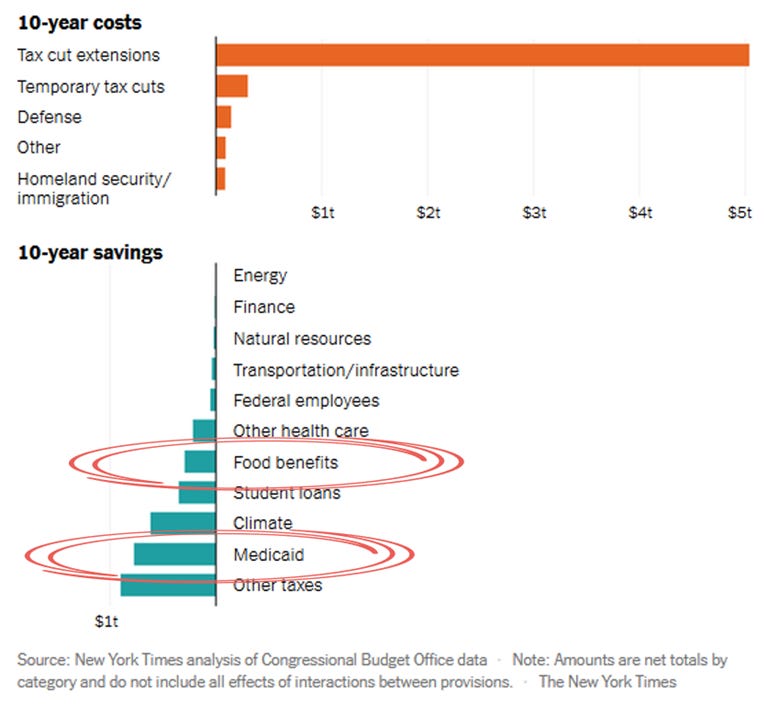
And if this bill passes as is, how are we going to pay for these tax cuts that mostly benefit the rich? We’re going to limit the number of people who can access their healthcare through Medicaid, and we’re going to limit the number of people who can access healthy food to feed their family through SNAP. The New York Times made a nice graphic that makes this pretty clear (red ovals added by me):
What is actually changing?
OK, but what are some of the specific changes featured in the bill the Republican House just passed?
Here’s the big one: It adds a work requirement to Medicaid for childless adults, mandating that they prove they are working, volunteering, or attending school for at least 80 hours every month to stay enrolled. Now this might not sound so bad. What’s so tough about asking people to work, volunteer, or go to school? The problem isn’t asking people to work. It’s about making them prove they are working. The work requirements passed in the House bill are actually less flexible than the work requirements imposed in Arkansas in 2018, which caused 18,000 people to lose coverage within 9 months before a federal court struck it down as unlawful because it contradicted “the ‘core’ objective of Medicaid: the provision of medical coverage to the needy.”
Why was this? Miranda Yaver, an Assistant Professor of Health Policy and Management at the University of Pittsburgh explains: “To first set up an account on Arkansas Works, there was an 8-step process that required 5 security questions. Then they had to link the Single Sign On account to the health care coverage account, which required three additional steps and they had to enter online a reference number mailed or emailed to them. Then there were 13 separate steps to report work hours, with additional steps required if beneficiaries held more than one job, and there were still 11 separate steps to report volunteer hours or an approved exemption. And all of this documentation is particularly difficult if one is maintaining inconsistent work hours or doing gig work.”
Plus, despite what you might have heard (because it’s an often-repeated Republican talking point), most adults under age 65 who are on Medicaid are already working. Increasing the burden on people to prove they’re working doesn’t result in more people working, it results in fewer people being able to access the healthcare they need.
It’s not just the work requirement that’s “saving money” to offset the tax cuts by limiting access to Medicaid. Here are some other changes that will go into effect if the Senate doesn’t alter these pieces of the bill:
-
States will be able to charge Medicaid patients up to $35 in co-pays every time they seek medical services, if they make more than the federal poverty limit—around $15,650 for a single person. Do you think you’d have any trouble paying your bills making under $16,000 a year? $35 is a lot of money for someone who’s struggling to make ends meet, and might quite literally stand in the way of someone seeking the healthcare they need.
-
The regulation that required nursing homes to meet a minimum standard for staff-to-resident ratios? That would be cancelled—saving $23 billion, and meaning that when grandpa needs to go to the bathroom, there might not be enough people around to get him there safely.
-
Transgender people—both minors and adults—wouldn’t be able to access gender-affirming medical care through Medicaid. Trans and poor? Too bad, you can’t get care that will improve your mental health and help protect you from violence.
-
Don’t have the paperwork anymore that proves you’re a U.S. citizen? Sorry, your state won’t be able to enroll you in Medicaid. Better deal with the bureaucracy involved in getting a legal copy of your birth certificate before you need healthcare.
-
If your state thinks that undocumented immigrants should be able to get healthcare when they need it—and uses their own funds to cover the exorbitant costs of U.S. healthcare outside of Medicaid—then it would have to pay more for people who qualified for Medicaid under expansion programs, as a punishment.
-
The rule that made it easier for low-income people receiving Medicare to sign up for help paying their premiums? Also cancelled—saving $85 billion because fewer people who need help paying their premiums will actually get the help they need.
-
Instead of making people jump through hoops once a year to prove their eligibility for Medicaid, now it will be every 6 months—plus, the rule that was supposed to simplify enrollment paperwork would be postponed. Do you like going to the DMV and hoping your complicated set of paperwork is in order so you’re not wasting your time in line, sent back home to return yet another day? This is like that, but you’re sick and can’t get healthcare until you get it right. Every 6 months. And if you don’t do it correctly in time, you can have your Medicaid terminated, making you start over again.
How big of a deal is this?
Since the Affordable Care Act expanded Medicaid access in 2010, an estimated 27,000 lives have been saved. A recent, comprehensive study found that people who gained healthcare access through Medicaid expansion were 21% less likely to die in any year than poor people who didn’t enroll. These deaths weren’t just prevented among older people, but also those in their 20s and 30s. Medicaid literally saves lives. Shouldn’t we be trying to expand such a life-saving measure, rather than slashing it to pay for tax cuts for people who’ve never had to think twice about whether they could afford a doctor when they’re sick or injured?
Whether these cuts will affect you—or your neighbors, or your loved ones—depends on a few things. Your Local Epidemiologist laid this out very nicely, so I’ll just quote it directly:
The impact of this bill will depend on where you live. KFF outlined a few key factors:
-
State budgets: Each state will respond differently to the loss of federal funds. For instance, states that expanded Medicaid to cover long-term care may see that as an area to cut first.
-
Population needs: States with higher rates of unemployment or poorer overall health will be hit harder.
-
Access to care: The more limited the healthcare infrastructure in a state, the more damaging the cuts could be.
States like West Virginia and Mississippi are likely among the hardest hit. Below is a breakdown of the most affected states, depending on what factors we take into account.
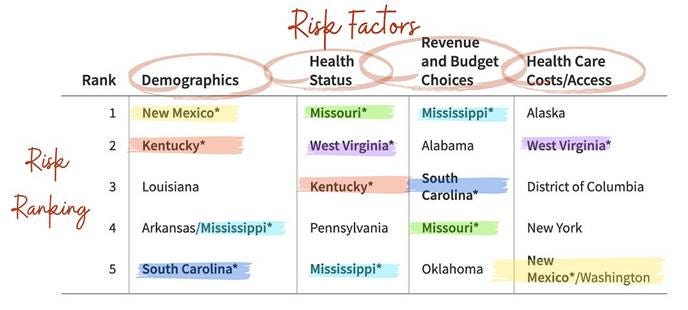
Source: Kaiser Family Foundation; Annotated by Your Local Epidemiologist
What happens when people with low income lose Medicaid (or can’t get it in the first place)? They don’t stop being sick or injured. Instead, when they get sick or injured they avoid going to the doctor until things have become so severe that they can’t avoid it anymore, and they end up in an emergency room. This means that other people in the emergency room who are having health emergencies have to wait longer, no matter what health insurance they have. It also means that when that people with low income receive a bill for thousands of dollars in emergency room care they can’t pay, and the hospital has to eat the costs of that care, which affects their bottom line and ability to stay open—especially in rural areas, where hospitals are already more likely to close. Then the next time someone in that rural area has a heart attack or stroke, they will have to travel further to get life-saving care in a hospital, and they’re less likely to survive…regardless of what health insurance they have.
We are all connected. These decisions affect all of us, not just certain groups of people who are easy to stereotype, dismiss, and see as “other.”
So what am I doing about it?
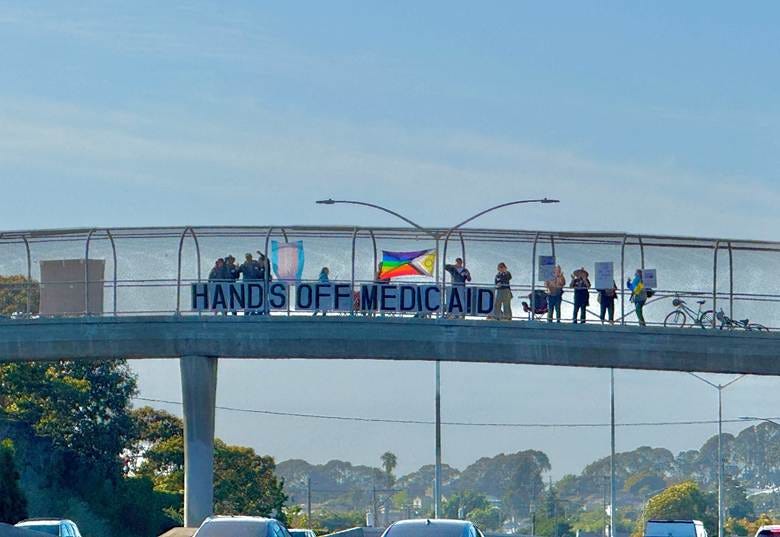
I’m writing this update to try to spread the word. I’m calling my senators to make sure they insist on changes to the bill so that Medicaid is protected. And today, I went to a protest in the pedestrian overpass on the highway right by my house. Kudos to my neighbors who organized it and made it easy to attend. We all can do something—no action is too small. I hope you’ll join me in taking action today!