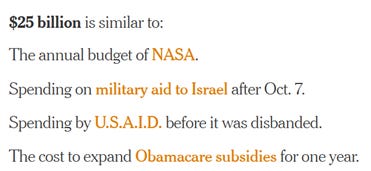
By April 29 of this year, the United States government had spent $25 billion on the war with Iran. To put that into perspective, in the two months after “Operation Epic Fury” began on February 28, more money was spent on Trump’s temper tantrum with Iran than an entire year of spending by USAID before it was demolished by Elon Musk and Donald Trump in 2025.
If you were one of those people who heard about USAID and thought, “Well, we shouldn’t be putting our hard-earned tax dollars overseas anyway, we should be spending them on Americans at home,” how do you reconcile the fact that the money “saved” by dismantling USAID has been spent bombing schools and endlessly negotiating the opening or closing of the Strait of Hormuz, while the price of gas skyrockets?
Maybe, for whatever reason, the now-defunct impact of USAID on people worldwide isn’t compelling to you. If you need some other comparisons to get a sense of scale here, the NY Times did a pretty great interactive article on this, at the 2-month anniversary of the war. Spoiler alert: this graphic sits at the top of the page:
The Guardian also did some comparisons of the money being spent in Iran, and how that money might instead be spent on social services. They looked only at the $12.7 billion dollars spent in the first six days of the war in Iran:
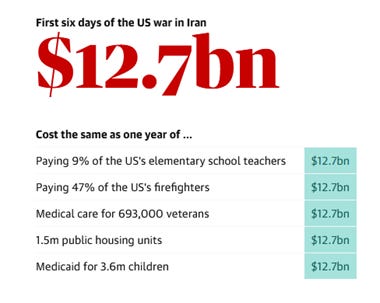
To me, the size and speed of money spent is mind-boggling. Just this morning, while I was writing this post, the acting comptroller of the Pentagon testified to the House Appropriations Committee that today’s official estimate of money spent is now closer to $29 billion. (Many credible people have claimed repeatedly that this official spending estimate is likely a serious undercount of the real costs.) We’ve also got a White House that submitted a request for $1.5 trillion in military spending for FY2027, the largest request in US history, and a “sizeable increase over last year’s budget,” according to the Pentagon’s own comptroller—a 42% increase over this fiscal year’s budget, to be precise.
Sure, that’s just a budget request. Congress might not approve it. But the $29+ billion spent—and the billions surely about to be spent—on this fight with Iran aren’t a request. That’s money that’s already gone out the door.
But I’m not here to talk about politics in general, I’m here to talk about its effect on health. We all know how money works. Military spending comes at a cost of other things. How is this record-setting military spending being offset? By cutting funds meant to support the health of Americans (including, by the way, American military families.)
The President’s proposed budget has a requested 42% increase in military spending for FY2027, and also called for $73 billion in cuts to domestic programs, including eliminating many of the health, education, and housing programs that millions of Americans rely on to keep their heads above water financially.
7 in 10 Americans say more taxpayer dollars should be spent to advance science and technology in the US. Yet this budget proposes to cut $5 billion from the National Institutes of Health (a 12% reduction in its budget), and the Administration has already cut $150 million from ARPA-H, a 10% cut even before the FY2027 budget is passed. ARPA-H, or the Advanced Research Projects Agency for Health, is a federal funding agency designed to accelerate biomedical and health breakthroughs. Related, thanks to the Trump Administration, China officially surpassed the US in R&D spending this March. These decisions being made to damage science in the US have widespread and long-lasting implications.
OK. Maybe you don’t care if China becomes the most innovative and most powerful research entity in the world, leaving the US in the dust. How do you feel about our life expectancy?
Paul Krugman from the NY Times explained this very well:
Most Americans appear to be unaware of the fact that life expectancy in the United States is substantially lower than in other advanced countries; we’re on a par with poorer nations in Europe like Albania. Surely even fewer people know that this wasn’t always true. In the early 1980s Americans lived about as long as citizens of other rich nations. Now we die substantially earlier:
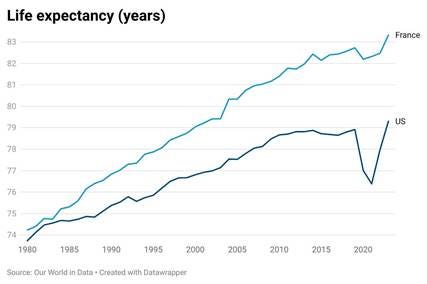
Maybe you think Paul Krugman cherry-picked France to make us look bad? You can see for yourself. The United States currently ranks #62 in countries for our life expectancy, behind not just France and almost all other European countries but also the United Arab Emirates, Bahrain, Costa Rica, Chile, Panama, Oman…and yes, Albania.
Surprising no one, the budget also proposes (again) to eliminate the National Institute on Minority Health and Health Disparities (NIMHD). Because if you don’t study health disparities, that makes them disappear! (Except no. Unfortunately it just makes them unmeasured. In fact, it will undeniably make them worse.)
These aren’t all future problems. The One Big Beautiful Bill Act was signed almost a year ago, and has already set into motion cuts to federal Medicaid that are projected to be $911 billion by 2035. These cuts were engineered to mostly hit after this year’s midterms, to delay any political fallout, so the biggest pain is still coming. Regardless, many safety net hospitals are already struggling financially. KFF Health News found some hospitals projecting deficits of $80-$100 million just next year; this is the kind of thing that closes hospitals and makes people have to travel dangerous distances for emergency, life-saving care. If you live in a rural area or a low-income part of a city, this could be you—if you suddenly had a heart attack, you would be more likely to die trying to get to a hospital that’s far away.
One of the major problems facing public health is that we are victims of our own success: when public health professionals succeed in their jobs, everyone is healthy and none the wiser. Success equals invisibility, and unfortunately invisibility equals cuts in funding. Then without adequate investment in public health infrastructure, we have a deadly disease outbreak or a natural disaster or teen pregnancy rates skyrocket or people start dying from drug overdoses in devastating numbers, and then suddenly we declare an emergency and the money flows again. This happened during COVID, remember? But our attention spans are short, and that flow of money has already been turned off. Treating public health with this “cycle of panic and neglect,” as pediatrician and California State Senator Richard Pan said to The Guardian last month, is a problem. “We don’t do that to the fire department,” he said. “Public health is part of public safety, and we need to have a baseline of support for that…[it’s] a core function of government”. (Or at least it used to be seen that way.)
So…what?
It’s not enough that we just complain about what the Trump Administration is doing; we need to propose actionable, meaningful alternatives. On April 6, Defend Public Health—a group I volunteer with that is working to protect public health infrastructure from the Trump Administration’s anti-science actions—launched guiding principles for political campaigns that want to prioritize public health, called the People’s Health Platform. This platform highlights the importance of ensuring healthcare for all; restoring scientific integrity; protecting and expanding sexual, reproductive, and gender-affirming healthcare; recognizing the dire threat pollution and climate change pose to life and health; preparing for the next pandemic; and taxing billionaires so we have enough money to build a strong public health infrastructure that keeps us all safe.
Give it a read. Share it with your representatives, or the politicians you hope will represent you after the midterms. Volunteer to help turn the tide. Where our government spends our taxpayer dollars matters a lot. If they’re spending it on bombs to drop abroad instead of improving lives at home, that’s bad for everyone. Public health means the health of all of us. We all need to demand change, before even more damage can be done. Join me in speaking up today!