Warning: I’m a little salty. Read on and you’ll understand why. Also, this is the longest What in the Health?! I’ve written to date. Sorry, but there was just so much to say. Future posts will be shorter. But I hope you’ll grab a cup of coffee or a glass of wine and make the time to read this through. I think it’s worth it. Tl;dr: We are not Denmark. Denmark is pretty awesome. Our government is a shitshow and the ACIP now has zero credibility. Continue to vaccinate your newborns for hepatitis B before they leave the hospital.
It’s time for yet another installment of what the WaPo editorial board referred to as “the CDC’s next anti-vaccine clown show.” Publishing the opinion right before last week’s meetings of the Advisory Committee on Immunization Practices, or ACIP, on December 4 and 5, the editorial board wrote:
“There is little hope Kennedy and his fellow travelers will acknowledge such facts [about hepatitis B vaccination]. Not when President Donald Trump pronounces from the White House podium that vaccines cause autism, contrary to dozens of studies. And not when the government’s top vaccine regulator casually uses an internal memo to announce that coronavirus vaccines have killed at least 10 children, without any data to back it up. It’s dogma, without scientific scrutiny.
This is probably why Kennedy’s appointees are not releasing much information ahead of their meeting. Or they simply don’t know what they’re doing. During their last meeting, in September — when they first attempted to delay the hepatitis B shot before ultimately tabling the issue — many seemed bewildered by simple matters of process.”
A lot happened at that meeting, besides the >60 “falsehoods, distortions, and outright lies being megaphoned from one of the nation’s highest committees.” I’ll give you the highlights. You probably heard about the change re hepatitis B vaccine for babies, and that’s a big one, so I’ll save it for last.
1. The ACIP chair was new (again).
3 days before the meeting, RFK Jr. appointed former ACIP chair Martin Kulldorff to a new influential role at HHS–chief science officer for the Office of the Assistant Secretary for Planning and Evaluation (ASPE). Kulldorff was no friend of the vaccine, but he had shown himself willing to limit some of the most anti-science agenda pushing during the committee. He wasn’t a great leader of the committee but he did try grounding conversations at least somewhat in data.
By moving him into HHS and thus off of ACIP, RFK Jr. was able to install Kirk Milhoan as ACIP chair, instead. The wreckage RFK Jr. has created of the system thus far has clearly not gone far or fast enough for him. Milhoan is a senior fellow to the Independent Medical Alliance, an organization created early in COVID, known for promoting unproven COVID treatments such as ivermectin. He’s also gone on record tying COVID-19 vaccines to increases in miscarriages and cancer, things that simply aren’t supported by data.
No matter what, as UC Law professor Dorit Reiss posted on Bluesky, “Dr. Kulldorff had done a pretty poor job running ACIP…[but] appointing someone without experience three days before a meeting is not likely to make the meeting run more smoothly or better.”
2. The presentations were not made by expert scientists.
There was no vote last week on the childhood vaccine schedule, beyond hepatitis B. But the groundwork was clearly being laid for more major changes.
No CDC scientist presented at the meeting, which was highly unusual, as this used to literally be the main job of numerous scientists. To be fair, on Friday morning ACIP member Robert Malone noted that two high-profile vaccine proponents—Dr. Paul Offit, director of the Children’s Hospital of Philadelphia’s Vaccine Education Center, and Dr. Peter Hotez, director of the Texas Children’s Hospital Center for Vaccine Development—had been invited to speak, and both declined. Offit explained, “I don’t want to legitimize what I think is an illegitimate process. I don’t want to be part of a process that gives bad advice, that’s putting children in harm’s way.” Hotez said something similar.
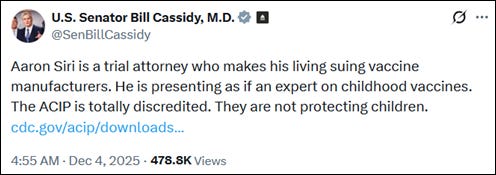
Instead, on Friday Aaron Siri—an attorney with ties to RFK Jr.—led the committee through an excruciatingly (and unusually) long 76-slide presentation about the childhood vaccine schedule. His presentation was so filled with falsehoods and misrepresentations about vaccines that when he finished ACIP member Cody Meissner—an actual pediatrician—said into the microphone, “What you have said is a terrible, terrible distortion of all the facts,” and “I don’t think you should have been invited.”
US Senator Bill Cassidy—a physician who had the power to stop RFK Jr.’s confirmation but was swayed by lies and false promises—posted on X:
Gee, too bad we couldn’t have seen this coming, Senator Cassidy.
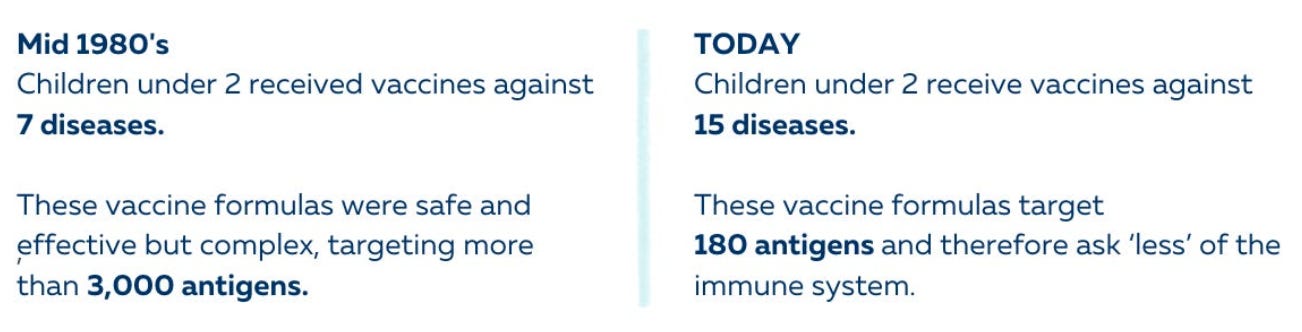
I’m sure many of you reading have heard the same talking points that Siri and others repeat over and over as if they’re true. They often claim that children receive “72 shots” or “96 doses” from the childhood vaccine schedule, but this is intentionally misleading.
Children whose parents follow the current vaccination schedule receive about 54 doses of immunizations by age 18. About a third of those are yearly flu vaccines. To get to 72 or 96 doses, one has to count not only a yearly flu vaccine (18 doses) but also a yearly COVID-19 shot (another 18 doses), plus count combination vaccines (like the MMR) as separate vaccines—or count vaccines that pregnant people receive, since those also benefit the child before they are born.
This is what science has done for us. We should be thrilled. I, for one, am thrilled that my child (now 17) was able to be so much more protected from debilitating infectious diseases than I was, born in 1980. Kids born today will be even better off than my kid is…if we’re able to limit the further destruction of this administration.
3. The committee—as expected—changed the recommendations about the birth dose of the hepatitis B vaccine.
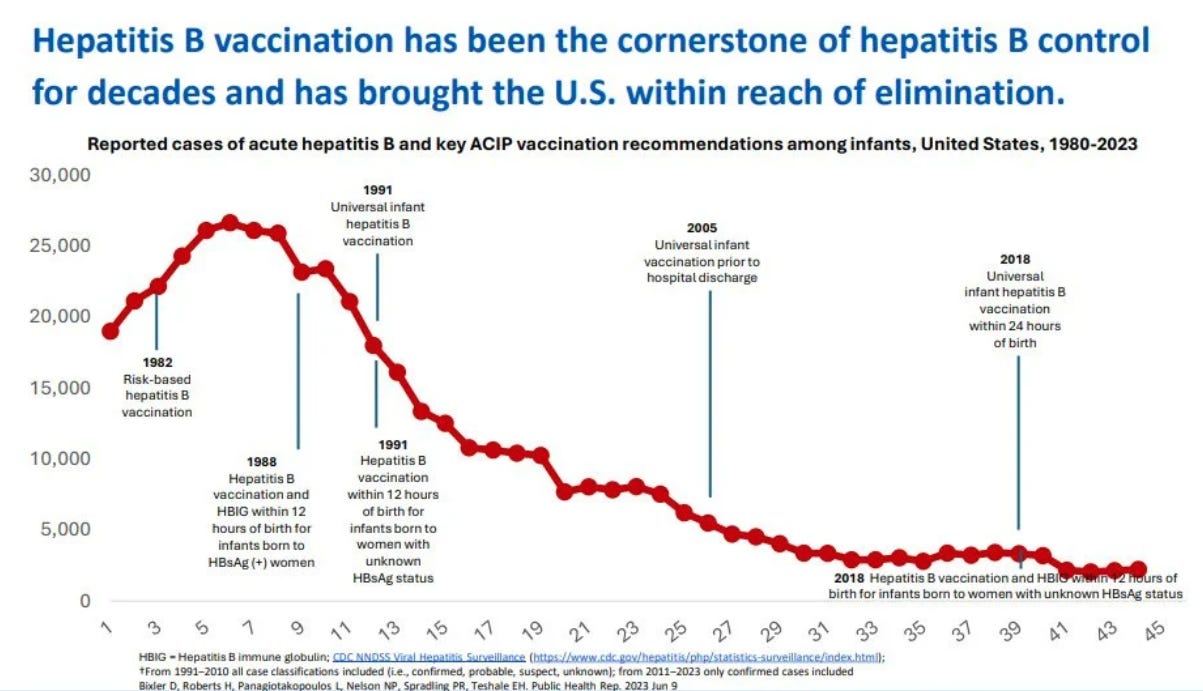
I gave a detailed explanation of this issue and why it’s a problem in a previous post. Dr. Paul Offit also wrote on his own Substack about how infuriating this is, because earlier attempts to recommend hepatitis B birth doses only for babies of mothers known to have hepatitis B, or babies born to people at highest risk of hepatitis B infection, simply didn’t work. The only real changes in the numbers of babies infected with hepatitis B (and subsequently dying) came once the universal birth dose was recommended in 1992. So the ACIP has now voted to recommend we return to a strategy that didn’t work the first time, over a decade when we tried it. Awesome. If you want even more details, you can read The Vaccine Integrity Project’s new Hep B Evidence Brief here.
At this point, I’ll be honest. I’m feeling pretty exasperated about all this, and pretty salty. Maybe it’s because this once-scientific, highly respected committee has been gutted, with members replaced by RFK Jr cronies who have said absurdly false and incredibly stigmatizing things. ACIP member Vicky Pebsworth blamed gay men, promiscuous women, and immigrants for spreading hepatitis B. Evelyn Griffin declared that “illegal immigrants” are to blame. Michael Belkin said—on the record, mind you—that hepatitis B is a disease of “junkies, gays, and promiscuous heterosexuals.” These are the people who have been appointed to lead the nation’s scientific committee that largely controls our access to vaccines, and whether we have to pay for vaccines out of pocket or not. They said these things into microphones. With thousands of people watching. In 2025.Are you kidding me?!
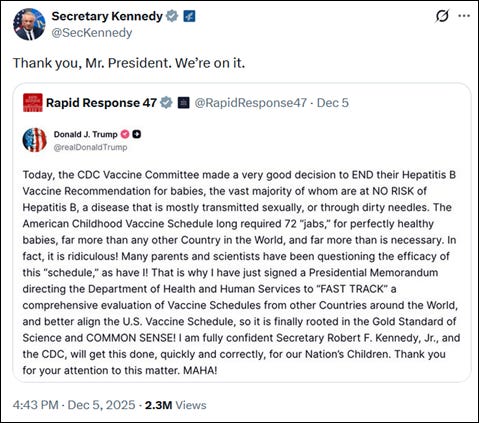
Maybe I’m salty because the celebrations happening on social media are just gross. Trump posted a long and characteristically inaccurate and unprofessional message on Truth Social, which RFK Jr. reposted with the response: “Thank you, Mr. President. We’re on it.”
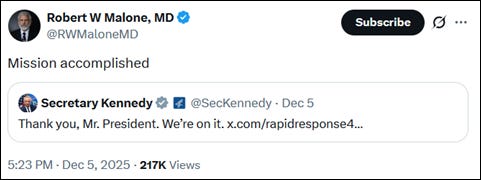
Then Dr. Robert Malone, an ACIP member known for his anti-vaccine views, reposted that, with “Mission Accomplished.” Very scientific approach, for sure. Love this professional committee.
Maybe I’m salty simply because people are going to die because of this decision. Actual people, actual deaths. Sort of like when George W. Bush proudly claimed “Mission Accomplished” for the Iraq War being over and won, before another 4,292 US soldiers and 100,000+ Iraqis died violent deaths in said war.
For these reasons, I’ve decided that instead of all the scientific, objective, and professionally written reports of this ACIP decision, I’m going to share with you the (still scientifically accurate) one that is really speaking to me most:
CDC staff and outside experts tried. They really did. They explained what this disease is, what is does, how infectious it is, and how the mass immunization program starting in the early 90s saved thousands of children from infection, from long term complications, and an ultimately early death for some. Here is one simple chart that CDC staff presented to ACIP earlier this year on the matter.
How in the actual hell do you look at that chart and decide vaccinations have to go?
Let’s talk about the actual decisions that were made.
Vote 1>The ACIP recommended the birth dose of the hepatitis B vaccine no longer be given at birth in the hospital by default, but delayed if desired, at least until the pediatrician’s visit at 2 months of age.
This matters for reasons I’ve already laid out. The implications of this vote are that hundreds of people will contract deadly chronic liver disease in the next decade, because they were infected with hepatitis B unnecessarily at birth. Totally avoidable—and we know this, because we have data proving the vaccine is safe and prevents this type of death, from 1992-2025—the years the prior birth dose recommendation was in place.
IMPORTANT: if you have a baby now and you do want them to get vaccinated at birth, you still can (and should) get that vaccine in the hospital, and have it covered by insurance. You can opt in. It just isn’t the default anymore.
Vote 2> Parents should ask their kid’s pediatrician to test their baby’s blood for hepatitis B antibodies after the first dose, to see if they’re already immune and don’t need the subsequent doses.
This one was really bananas. There is zero science to back up this recommendation. Yes, there is an established titer threshold for antibodies to hepatitis B, thought to be protective. But this applies to adults who have been fully vaccinated (or already naturally infected with hepatitis B—which, by the way, is lifelong and incurable). In clinical trials, scientists have conclusively determined that three doses of the hepatitis B vaccine are enough to reach that immunity threshold and give someone protection. That’s why the hepatitis B vaccine is three doses. We have no science that demonstrates whether a baby who reaches that established titer threshold after one dose will retain antibody levels above that threshold, and stay protected without the subsequent doses. Antibodies can wane. (This is why you need to keep getting COVID boosters.) We don’t know if this strategy of testing antibody levels after one shot is safe and effective. But the ACIP just voted to recommend that be a practice that parents and their health care providers adopt for their newborn babies.
Plus, the ACIP recommended that insurance cover the cost of that lab testing. But ACIP has no authority over that. They only have authority over immunization policy, and whether insurers have to cover immunizations. So that part of the vote holds no weight. It also means that—even if insurance were to pay—infants would have another blood draw (with risk of infection) plus another doctor’s visit to get results and be immunized if indicated. It costs our health care system more, even if it doesn’t cost individual families more. And again, we have no science at all to back this up. Cool, cool. “Gold standard science” we have here. Thanks, Trump and RFK, Jr. Making us all healthier. Maybe. Or actually not.
I’m not the only one who thinks this is bananas. Three different ACIP members asked repeatedly about the scientific basis for these decisions, and ultimately voted against both changes. Remember, these are RFK’s hand-picked people, so this much disagreement should be a big red flag for all of us.
Dr. Cory Meissner (a pediatric infectious disease specialist) responded to a presentation at one point with, “There were so many statements that I disagree with, it’s hard to be succinct.” When he voted no, he said, “Do no harm is a moral imperative. We are doing harm by changing this wording.”
Dr. Kirk Milhoan, the new ACIP chair, said that the two month timepoint was chosen because it was a point at which infants had matured beyond the neonatal stage. ACIP member Dr. Joseph Hibbeln then said there was no data presented to back up a claim that two months is an appropriate cut-off. “This is unconscionable,” he proclaimed. Dr. Raymond Pollack, a transplant surgeon who has likely transplanted a lot of livers for people dying from their hepatitis B infection, also voiced strenuous objections throughout the meeting, and voted no on the first vote along with Drs. Meissner and Hibbeln.
When it came to the second vote (about the antibody testing before the 2nd or 3rd doses), even Dr. Milhoan had concerns. Adam Langer, a CDC subject matter expert who wasn’t asked to present but was called in to comment on the proposal before the committee, said that the committee “would be making a real huge assumption” to conclude that a baby having achieved the titer threshold after one dose would have durable protection against hepatitis B without further doses. Milhoan then said he would be most comfortable voting instead to recommend further study on the issue of whether three doses are really needed. But in the end, he didn’t propose a change to the voting language, and voted with the majority to recommend testing after one dose, which passed by a vote of 6-4 (with one member abstaining). Cool.
OK, so what does all of this have to do with Denmark??
No one at the ACIP meeting ever suggested there was new scientific information about effectiveness of the US childhood vaccine schedule, nor that there were new safety concerns about any vaccines. Panelists blatantly pointed out the ACIP review of the hepatitis B recommendations was prompted by parents concerned about the vaccine, and the fact that most European counties give the hepatitis B vaccine a few months after birth, not right away.
Tracy Beth Høeg, a longtime critic of broad COVID vaccination for children (and new acting director of the FDA’s Center for Drug Evaluation and Research), was brought in to brief the committee on the difference between the US and Danish vaccine schedules. She’s a dual Danish/US citizen, so naturally she was the best choice for presenting this critical information on vaccine schedules. The White House also named Denmark as a “peer nation” in a fact sheet about Trump’s Friday directive to review international approaches to childhood vaccination in “peer, developed countries.”
In case you’re saying to yourself, “Yeah, but Denmark is tiny and the US is huge, you’re comparing apples to oranges,” scientists have done the math for you. The rate of newly diagnosed chronic hepatitis B infections in the US in 2023 was 6.1 per 100,000 people, and in Denmark it was only 1.7 per 100,000 people.
But there’s a bigger difference between our two countries: people in Denmark have free, universal healthcare. That means they don’t hesitate to go to the doctor for testing or treatment. Denmark also has one of the best disease surveillance systems in the world. They know when people have infections, and they take steps to get them treated and healthy. In the United States, only 1 in 3 women living with hepatitis B receive care for their infection, and 1 in 5 pregnant women in the US are not tested for hepatitis B. In Denmark, virtually 100% of pregnant women receive hepatitis B testing, and virtually 100% of people who have been diagnosed with hepatitis B receive ongoing care for it.
If we want to use Denmark as a model, then let’s use Denmark as a model! I for one would love to pay more taxes and have a social system that actually cares for its citizens, making them happier and healthier as a result. (Gasp, I know. I just said one of the worst possible things for an American to say. Pay more taxes?!) Here are some examples of how our countries compare:
^The U.S. is the only wealthy nation with no federally mandated paid parental leave. The Family Medical Leave Act will protect someone’s job for 12 weeks under certain circumstances, but it can be unpaid.
†The U.S. Fair Labor Standards Act (FLSA) does not require employers to provide payment for time not worked, including vacations or holidays. Under the Danish Holiday Act, all employees are entitled to 5 weeks of paid vacation every year.
‡This is actually the average annual income (all I could find), not the median, but since Denmark has one of the lowest income inequality coefficients in the world, the average is pretty close to the median (unlike the US, where a small number of extremely wealthy people skew the average).
This comparison isn’t just for fun. Our health isn’t just shaped by the medical care we receive. It’s shaped by all sorts of socioeconomic and environmental factors, including stress, happiness, and the very things in this table above. As Jessica Malaty Rivera from Defend Public Health recently said, “The exposure rate, the disease status rate in the U.S. is terrible, and that’s why we have the policy that we have to protect children. We shouldn’t be asking what another country is doing. We should be asking, ‘What should we be doing based on the exposures and risks and concerns that we have for our population?’” The Danes don’t need to vaccinate their babies for hepatitis B in the hospital, before they leave. In the United States, we absolutely do. We are not the same as Denmark.
In closing: Stick with the science.
The science around hepatitis B vaccination hasn’t changed—the politics in our government have changed. You can get the most up-to-date version of the childhood immunization schedule from the American Academy of Pediatrics here. Screenshot it, download it, print it if you want, and bring it to your next pediatrician’s appointment. This is the gold-standard science. The ACIP cannot be trusted, and should be ignored.
The American Academy of Pediatrics isn’t the only science-driven institution that acted quickly to protect children’s lives, and speak out about best practices for hepatitis B vaccination after last week’s meeting.
The West Coast Health Alliance, including the Washington State Department of Health, the California Department of Public Health, the Oregon Health Authority, and the Hawaii Department of Health all came out strongly in favor of the birth dose still being given by default in hospitals in those states. The Maryland Department of Health issued a standing order for hepatitis B vaccination to help maintain access for all newborns. The Northeast Public Health Collaborative (which includes CT, DE, ME, MD, MA, NJ, NY, PA, RI, VT & NYC) released a statement that they continue to recommend that all newborns receive a hepatitis B vaccine birth dose within 24 hours of delivery.
Our states are stepping up and sticking with the science. They shouldn’t have to fill the void left by the feds, but that’s where we are. You can—and definitely should—stick with the science, too.