Depending on what anniversary date you want to use, it’s been just about exactly 5 years since the COVID pandemic started. (It started earlier in China, of course, and had already spread to Italy and but “pandemic” means it spread worldwide, which really started to happen in a big way by early March 2020.) It was March 9, 2020 when Italy was the first country to implement a nationwide quarantine protocol, and on March 16 six San Francisco Bay Area health officials ordered a shelter-in-place order that affected about 7 million people in those counties. Many others around the U.S. and the world soon followed, of course.
So here we are, 5 years out. This isn’t really a post about COVID, it’s about what we learned as a society in the United States—or more precisely, what we didn’t learn.
Check out this shocking graph from Nicolas Rapp, using data from the UN and Our World in Data. The US spends a LOT more on healthcare per capita than other similar countries, and we do not see the benefits you’d hope we’d see. Our life expectancy is a lot lower than so many other countries.
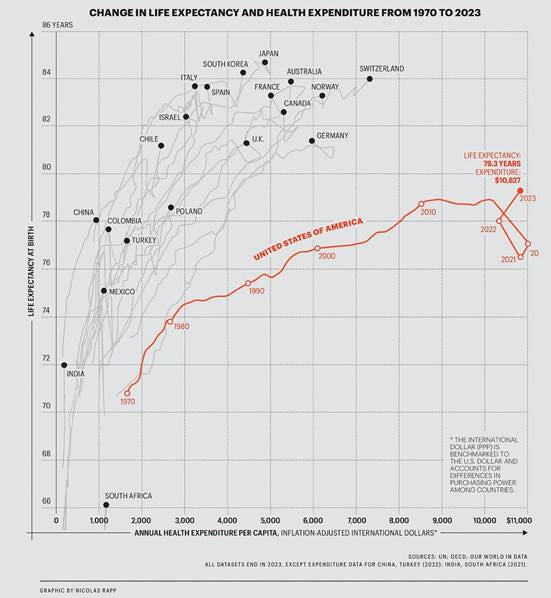
People in the United States are more likely than other high-income nations to die at younger ages of causes that are preventable or treatable, including much higher rates in the US of assault and complications of childbirth than any other high-income country. The US is also the only high-income country in the world that does not provide guaranteed health coverage to its residents. Somehow so many people in the US think that other countries envy our amazing, high quality health care. But that’s a myth. By and large, people in other high-income countries think our health care system is bizarre and something we should be outraged about.
People in the US aren’t dying sooner because there’s something wrong with us as human beings. This happens because there’s something wrong with our systems, and our societal approach to public health and healthcare. Our systems are failing us. And what are we doing to turn this around?
–We have a President (and apparently his speechwriters and advisors) who confused the terms “transgender” and “transgenic,” railing during the State of the Union against the US government spending $8 million on “making mice transgender,” and then doubling down later, releasing an official White House statement that claims in bold text that “The Fake News losers at CNN immediately tried to fact check it, but President Trump was right (as usual).” That very presidential statement then goes on to list 6 research studies it calls “transgender experiments” that (spoiler alert) have nothing to do at all with making mice transgender. And how can experiments be transgender, anyway? Experiments don’t have a gender. This whole thing is just bonkers.
–The agency administrator of the Environmental Protection Agency has eliminated all offices that are (were) designed to address the disproportionately high levels of pollution that people living in poor communities experience in the US, saying, “President Trump was elected with a mandate from the American people…part of this mandate includes the elimination of forced discrimination programs.” The problem is that allowing pollution to concentrate in areas where poor people live (and not coincidentally, areas where more Black and brown people live) IS forced discrimination! If you live in a poor community and can’t afford to leave, and because you’re there you have to breathe dirtier air and drink dirtier water and be exposed to more chemicals and the government closes down its efforts to put a stop to that, then the government is preserving and obscuring environmental discrimination. And in case you doubted that, last week the EPA and the Department of Justice decided to drop a pending lawsuit that the Biden Administration’s Justice Department had filed against a petrochemical plant that it believed was unnecessarily increasing the cancer risk in a mostly Black community in Louisiana. Make no mistake: this isn’t about trying to treat white and Black people equally in the US. It’s that this government cares more about petrochemical companies and the rich people at the helm of them than it does about the Black people whose lives are negatively affected by them.
–In one of the first round of staff cuts to federal agencies, Trump eliminated the team at the Center for Consumer Information and Insurance Oversight (CCIIO) that was in charge of implementing the No Surprises Act. This is the Act that went into effect on Jan 1, 2022 that was supposed to prevent insurance companies from sending large bills to patients unexpectedly after they received services because those services were “out of network” even though they were for emergencies, or were received in a healthcare facility that was in network (though the provider was not). And yes, Biden was president on Jan 1, 2022. But it was signed into law by President Trump himself, in 2020. “This must end,” Trump said when he signed it. “We’re going to hold insurance companies and hospitals totally accountable.” Well, for a few years at least, until he decided to gut the team at CCIIO that helps make that possible. So much for that.
–We’re eliminating research into vaccine hesitancy, when vaccine rates have fallen low enough in some parts of the US that we’re no longer benefitting from herd immunity, leading to outbreaks like the measles outbreak in the Texas panhandle. On Monday of this week, the director of the Office of Policy for Extramural Research Administration (a fancy term for “the person in charge of policies related to funding NIH gives to other researchers”) sent a letter to NIH officials requiring them to send termination letters by close of business that same day that needed to include the following language: “It is the policy of NIH not to prioritize research activities that focuses gaining scientific knowledge on why individuals are hesitant to be vaccinated and/or explore ways to improve vaccine interest and commitment…Therefore, the award is terminated.” Let me say this again. The US has had significant declines in vaccination coverage among children in the past few years. Especially since COVID, we know that vaccine hesitancy has contributed to lower vaccination rates among people who are already likely to have poorer health outcomes. (These are some of the “inequities” the government doesn’t want us to talk about.) We currently have more than 250 cases of measles in Texas and New Mexico, and two people have died. But in a great waste of resources, the US government is cancelling research projects—most of them mid-stream, with resources already spent but no results, yet—that were designed to help us understand how vaccine hesitancy is putting us all at risk, and what we might be able to do about it. As Michael Bronstein from the University of Minnesota Medical School said in the Washington Post, “From a public health perspective, preventing people from dying should be a government goal. Vaccine hesitancy is one barrier to that.”
–We’re not supposed to use a very long list of words anymore, because apparently the need to protect free speech doesn’t extend to this federal government. If you haven’t already seen this list, make sure to click the link and really read it. There are some words on there that won’t surprise you (like “DEI,” “non-binary”, or “pregnant people”) but there are so many others that might shock you (like “Black”, “mental health”, “pollution”, “women”, and “disability”, for example). As the article says, there’s no list that outright bans the use of these words. But that doesn’t mean that people are free to use them without endangering their ability to continue working or having funding to support what they’ve been doing, even if it’s meant to improve the life expectancy or save lives of fellow Americans.
To close with a bit of good news, on Thursday it became clear that there weren’t the votes in the Senate to confirm Dave Weldon, Trump’s pick to be Director of the CDC, and his nomination was suddenly withdrawn. To public health folks this is great news, as he is infamous for his anti-vax and anti-abortion stances among other things, which would have been terrible to have from the leader of the health agency that oversees vaccine recommendations and much of the US’s reproductive research and health care. But who is next in line to replace him? This might not be good news after all—we’ll have to wait and see.