Most of what I share through this Substack is pretty distressing stuff. That’s appropriate, IMO, because these are some pretty distressing times. And, this week is about to get verrrry interesting, since tomorrow Drs. Susan Monarez and Deb Houry are going to be testifying before the Senate HELP Committee (grab your popcorn) and then the Advisory Committee for Immunization Practice, or ACIP, is going to meet Thursday and Friday in Atlanta with its 5 brand new members, to vote on whether we all will have access to COVID vaccines, newborn hepatitis B vaccines, and the combined measles, mumps, rubella, and varicella vaccine (grab a pillow to muffle your screams).
But before all that, I found myself in Atlanta this week for some work, and yesterday a long-time friend of mine invited me to join him and many of his CDC colleagues for an event called “Compassion in Action: Saving the World One Sandwich at a Time.” It was co-organized by Sharoda Dasgupta from CDC; Leanne Rubenstein, Co-Director of Compassionate Atlanta; and Christine Cooper Nowicki, who volunteered with The Sandwich Project for many years and—after being RIF’d from her job at CDC in February—became the organization’s executive director. It was organized by and for people from CDC so they could come together, share some space and camaraderie, and put their energy into doing something that they knew would make a difference. That might seem simple or trivial in the grand scheme of everything that is happening, but I can assure you that if you were in that room it felt pretty darn profound.
Why sandwiches? Per The Sandwich Project’s website, 36% of Georgia families face food insecurity—more than double the national average. 1 in 6 children in Metro Atlanta go to bed hungry. As they note, “Food insecurity affects your coworker, your child’s classmate’s family, the person checking you out at the store.” To try to counteract this The Sandwich Project has worked with more than 20,000 volunteers since 2020 to make and distribute more than 2.1 million sandwiches to people without sufficient access to nourishing food. They work closely with community partners to ensure they’re reaching people who might not easily get food through more traditional sources, like food pantries. They put a heavy focus on food safety and most importantly dignity: we were told that if we made a sandwich we wouldn’t want to eat ourselves, then we shouldn’t add it to the bag.
Before we started, Sharoda (who gave me permission to share this) asked for a show of hands for how many people are—or were—affiliated with CDC. Almost every hand went up. Then she asked how many of those were affected by staffing cuts, even if ultimately rehired back? The vast majority of hands went up again. How many were recently separated from the agency? Many hands again. Silence. Eyes on the floor. Grief.
“To all of you, I just want to take a moment to thank you. Thank you for your service to the American people, to communities all over the world, and for coming today to support yourselves and each other,” Sharoda said. People stopped looking down and made eye contact with others. They were smiling. Recognizing their strength and the support they had from one another.
“We want today’s event to be a way for everyone to connect with each other, and stand shoulder to shoulder in serving our local community in a way that aligns with our public health mission of protecting people’s health and quality of life,” Sharoda said—and we did.
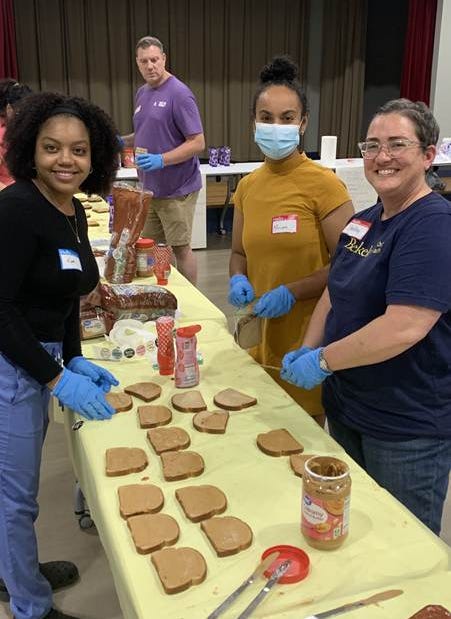
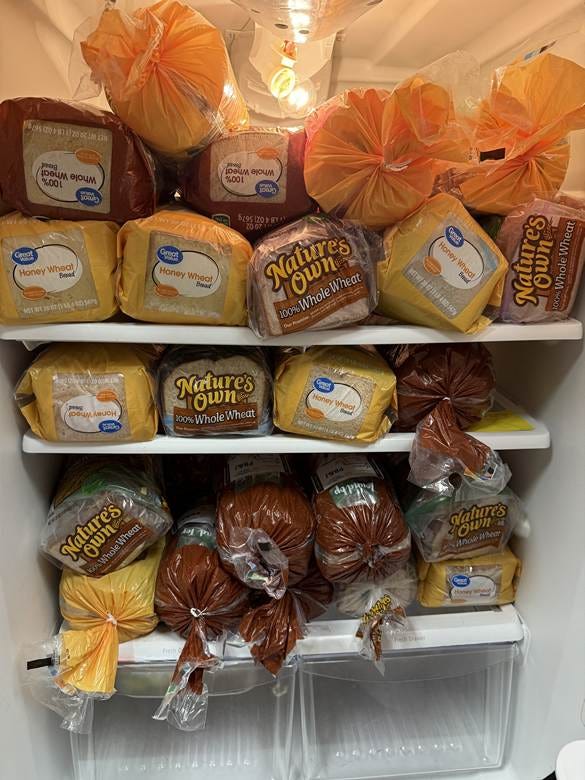
Together we made 300 sandwiches, which went out around Atlanta this morning to feed neighbors who might have had to “choose between rent and groceries, gas and dinner,” as it says on The Sandwich Project’s website.
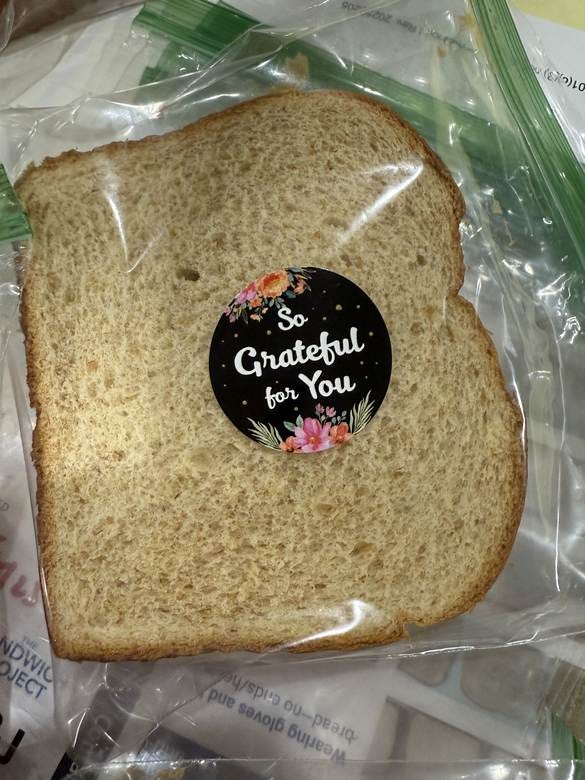
As a sweet touch that was symbolic of the evening—and of the thoughtfulness and kindness of most people who’ve chosen a career in public health, regardless of what you might have been asked to believe—every completed sandwich received a sticker that would hopefully brighten the day of the person receiving it the next afternoon.
When the world is constantly sending you messages that you’re not good enough, not working hard enough, not successful enough, not making enough of a difference—not enough—it can be hard to put on a smile, and hard to keep going. These folks who’ve devoted a career to public health and the CDC know this better than most right now, and they were determined to do what they could to turn someone else’s day around. If you’re reading this and don’t work in public health, please take a moment to reach out to someone who does and say thank you. Let them know you’re grateful for them. Tell them you care. It’s very possible that they haven’t heard that from anyone in many, many months.
❤️
Before I sign off I wanted to share five more uplifting things that have been happening in the world of public health! I hope this is fuel to get you through the week.
-
Between now and 11am Eastern time / 8am Pacific tomorrow (or maybe today, when you read this), you can go to www.saveaidsresearch.org to join a livestream and hear presentations from 70+ HIV/AIDS scientists, clinicians, researchers, and community advocates from around the world who are sharing their latest research and how federal funding has made their work possible. It’s part of an event called “24 Hours to Save AIDS Research” and if you missed it (since so late in sharing it) you can still watch the recordings and get inspired. In the past 40 years HIV research has saved tens of millions of lives, and this is an opportunity to learn about that impressive work and be spurred to action to prevent deep cuts that will set the US (and global) HIV response back many years—maybe even decades.
-
MedPage Today published a story with a pretty hilarious headline: Trump Admin Throws Up Hands, Pledges to Restore HHS Websites. You probably know that many, many websites from CDC and other places with HHS have had data or content removed or altered since January 30. (I wrote more about it here and here and here.) But after a lawsuit by AcademyHealth and others, the Trump administration settled. According to Aaron Carroll, MD, MS, president and CEO of AcademyHealth on MedPage Today, “they said, ‘We’re not even going to fight this. We’re just going to put everything back.” I’ll still be proceeding with caution, but this sounds like a win.
-
The House Appropriations spending bill (which is pretty awful in lots of ways, but not all) not only declines to fund RFK Jr’s plan to consolidate many HHS entities under a new “Administration for a Healthy America” but also includes $1.1 billion for the Center for Biomedical Advanced Research and Development Authority (BARDA)—including some portion to specifically fund mRNA vaccine research—after Kennedy announced he was terminating nearly $500 million in grants from BARDA for mRNA research. A clear statement indeed.
-
Surely you heard that on September 3, Governor Ron DeSantis and Surgeon General Joseph Ladapo announced they would be ending all mandatory vaccinations for children in schools in Florida. But within less than 48 hours Donald Trump called Ladapo’s announcement “a tough stance” and went further to say “You have vaccines that work. They just pure and simple work. They’re not controversial at all.” For once, I agree with him. Now Florida’s health department is walking back the original announcement.
-
Since RFK Jr. gutted ACIP and has taken so many steps to undermine the credibility of both ACIP and CDC—especially around vaccination—many states are taking action to make sure their residents can still access lifesaving vaccines. Massachusetts came out swinging, when Governor Marcia Healey “essentially wrote a prescription for COVID boosters for every person in the state over the age of 5.” She also started requiring insurers to follow state guidance (not ACIP or CDC recommendations) about which vaccines to cover, stating, “When the federal government fails to protect public health, Massachusetts will step up.” In New York, Governor Kathy Hochul signed an executive order authorizing pharmacists to administer a COVID vaccine, without a prescription, to almost anyone who wants it. California lawmakers are (hopefully) close to passing SB/AB 144, which—as simply explained by Dr. Matt Willis for Your Local Epidemiologist California—”removes all references to ACIP from state law, and replaces them with recommendations from professional organizations that rely on science, including the American Academy of Pediatrics (AAP), the American College of Obstetricians and Gynecologists (ACOG), and the American Academy of Family Physicians (AAFP). These physician-led organizations have issued annual vaccine guidance for decades.” Many other states—including Colorado, Maryland, Washington, Delaware, North Carolina, Pennsylvania, Nevada, and Kentucky—have also taken steps to ensure pharmacists can continue administering COVID vaccines regardless of what happens Thursday and Friday. (Whether insurers will pay for the shots or people will have to pay out of pocket, that remains to be seen.)
There’s a lot to be sad or angry about these days. But there’s a lot to be inspired about, too. Resistance is not futile. I’m so grateful for you. Pass it on.